Table of contents
- A.
Introductory remarks
- B.
Immigration and Refugee Board of Canada At-A-Glance
- C.
Budget and Human Resources
- Task Force on Less Complex Claims
- D.
Task Force on Less Complex Claims
- E.
Operational process
- F.
File Review Factual Corrections
- G.
Immigration and Refugee Protection Act – Claim for Refugee Protection
- H.
2019 Office of the Auditor General Audit
- Topics of interest
- I.
System Integrity
- J.
Bill C-12 – Impact on Immigration and Refugee Board of Canada
- K.
Pre-Removal Risk Assessment
- Divisions
- L.
Refugee Protection Division – Key Facts
- M.
Refugee Protection Division – Processing and Wait Times
- N.
Refugee Protection Division – Acceptance Rates for Top 10 Countries
- O.
Refugee Appeal Division – Key Facts
- P.
Immigration Division – Key Facts
- Q.
Immigration Appeal Division – Key Facts
- R.
Annex A: Committee Information
A. Introductory remarks
Opening Remarks to the Committee on Citizenship and Immigration (CIMM)
Date: March 9, 2026
Introduction
Thank you, Madam Chair,
I am accompanied by Roula Eatrides, Deputy Chairperson for the Refugee Protection Division, Gary Dukeshire, the Board’s Senior Counsel, also for the Refugee Protection Division, as well as Jason Hollmann, Director General of Asylum at Immigration, Refugees and Citizenship Canada (IRCC) and Brett Bush, Director General Immigration and Asylum Policy of the Canada Border Services Agency (CBSA).
I will focus my intervention today on the IRB’s paper-based decision-making, or “file review” process.
But before I start, and in order to situate the process let me say that every adult, making a refugee claim is interviewed by an officer of IRCC or CBSA when they make their claim before undergoing rigorous security screening.
This is the first step of the In-Canada Asylum System, towards refugee status or removal, where CBSA or IRCC decide if a claim is ineligible to be referred to the Refugee Protection Division (RPD) due to security, violating human or international rights, serious criminality or organized criminality.
They question the claimant to establish identity and determine eligibility; they gather biometric information and conduct criminal and immigration background checks through the RCMP, as well as security checks through the CBSA and CSIS.
Based on the results, IRCC or CBSA decide if the claim is ineligible to be referred to the IRB, and if eligible, whether the Minister should intervene on the case.
Once a claim is referred to the IRB, our role is to decide whether the claim is well-founded or not.
We do not duplicate the work of IRCC or CBSA but if at any stage of our process, we detect something that should be raised to the attention of the Minister, we formally notify them.
Which takes me to the file review process. The file review process was not a response to the Yeates Report, although Recommendation 26 did suggest that paper-based decision making should be considered, in as many cases as feasible.
The Board’s authority to accept asylum claims without a hearing, dates back to 1993, under subsection 69.1 (7.1) of the former
Immigration Act and is now found in paragraph 170(f) of the
Immigration and Refugee Protection Act (IRPA).
How and when we consider triaging a claim to the file process is the second point I wish to clarify.
We start by looking for a notice that the Minister intends to intervene in the case. If so, the file is screened to a full hearing.
Then we confirm that the Front-end security screening has been completed. If not, the file won't proceed, in any stream until it is.
When we look at a file for suitability into the file review process, we look at:
- countries or claim types that have an acceptance rate of 80% or higher, based on outcomes of regular hearings;
- where identity is established by reliable documents;
- where the evidence is
not ambiguous about the risk generally faced by claimants; and
- where complex issues do not arise.
And then there needs to be claimant-specific evidence—passport, birth certificate, membership cards, police reports, medical reports, etc.—in support of the claimant-specific allegations.
If all the requirements are met, we inform the Minister of our intention to proceed with the file process.
The Minister may choose to intervene at this point and, if they do, the case will proceed to a hearing.
Remember: triaging is an administrative transaction, not a decision.
It allows us to use our resources in proportion to the nature and complexity of the case at hand.
When a member receives a file to consider via a file review, the member exercises their discretion and if they feel it is required, redirects the case to a full hearing.
In 2025, 11,700 cases were finalized by paper-based review, which represents a bit more than 10% of 78,000 finalizations.
The file review process is a means to ensure that claims, where no issues of security have been detected and where the claim otherwise meets all the requirements of the act can be dealt with more expeditiously.
This allows us to concentrate our efforts on the majority of cases that require a full hearing to decide.
I shall stop here and turn the meeting over to you.
B. IRB at-a-glance
December 2025
Corporate
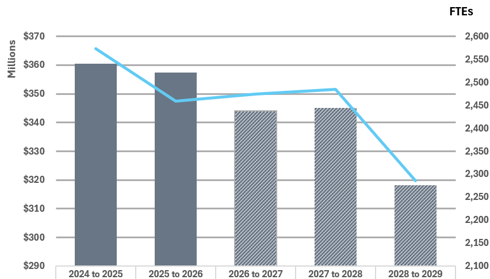
Text version
Total Budget
| 2024-2025 | 2025-2026 | 2026-2027 | 2027-2028 | 2028-2029 |
|---|
| Authorities | $360,445,208 | $357,511,436 | | | |
| Approved funding | | | $344,133,766 | $345,051,264 | $318,183,746 |
| FTEs (Actual and planned) | 2,573 | 2,459 | 2,475 | 2,485 | 2,286 |
| Expenditures 2025 to 2026 | Forecast (in thousands of dollars) |
|---|
|
Salary (including EBP) |
$287,035 |
|
O&M | |
Interpreters | $11,101 |
Translation | $6,407 |
Transcription | $4,079 |
Designated | $381 |
All others | $27,429 |
|
Total O&M |
$49,398 |
|
Total |
$336,433 |
Directive on Telework
- 3-days a week on site: validate managers’ attestation and card swipes
- Calgary – exception due to office capacity
- Pre-existing telework groups include linguistic specialists/RAD members and ADCs/transcription team/non-clerical ATIP
Horizon Efficiencies
- 1-800 Phone and Mail consolidation
- RPD Process leaning of Intake and Scheduling
- My Case Onboarding of all counsel, DRs and pilot of self represented
- NOVA automation of intake tasks and forms
- Reasons Navigator
- Manager self-service productivity
- Inventory management tools to improve triage
IAD/IAD/RAD
| ID Decisions/Wait Times | Decisions (Q1 to Q3 2025-2026)
| Wait Time (as of December 31, 2025)
|
|---|
|
Immigration |
Detention |
5,300 |
48 hours / 7 days / 30 days |
Admissibility |
1,700 |
4 months |
|
Immigration appeals |
3,100 |
6 months |
Family sponsorship appeals | 70% | |
Admissibility appeals | 18% | |
Permanent residency appeals | 11% | |
Appeals by the Minister | 1% | |
|
Refugee appeals |
8,000 |
4 months |
Interventions by the Minister | 1% | |
|
Total RAD-ID-IAD Decisions Q1/Q2 |
18,100 | |
| Total Decisions (Rounded) | 2022-2023 | 2023-2024 | 2024-2025 | 2025-2026 (Q1 to Q3 inclusively) |
|---|
|
Refugee Appeal Division |
10,900 |
9,800 |
9,400 |
8,000 |
|
Immigration Division |
10,300 |
11,300 |
10,400 |
7,000 |
Detention Reviews | 8,900 | 9,500 | 8,300 | 5,300 |
Admissibility Hearings | 1,400 | 1,800 | 2,100 | 1,700 |
|
Immigration Appeal Division |
3,100 |
3,200 |
4,000 |
3,100 |
|
Total |
24,300 |
24,300 |
23,800 |
18,100 |
RPD
| Decisions/Wait times 2025-2026 | Decisions (Q1 to Q3 2025-2026)
| Wait Times as of December 31, 2025 |
|---|
|
Refugee claims |
59,800 |
24 months |
Security screening | 100% | |
Interventions by the Minister | 7% (1% in person and 6% in writing) |
|
|
On Minister's initiative |
5% | |
|
On IRB's initiative |
2% | |
| Total Asylum Claim Inventory | Total Claims (rounded) |
|---|
|
Not Ready for Adjudication |
117,300 |
With claimant | 2,600 |
Pending security screening by CBSA | 100,400 |
Other (pending Minister's Information Package or other documents) | 14,300 |
|
Ready for Adjudication |
182,800 |
|
Total |
300,100 |
Overturned Cases (Q1 to Q3 of 2025-2026)
| Federal Court overturn rate of asylum decisions (FY to date) | <1% | 57 |
| Claimants Location in Canada (for Claims Pending as of December 31, 2025 | Total cases | Proportion |
|---|
|
Atlantic Provinces |
2,380 |
1% |
New Brunswick | 1,040 | 0% |
Newfoundland and Labrador | 400 | 0% |
Nova Scotia | 50 | 0% |
Prince Edward Island | 890 | 0% |
|
Quebec |
112,520 |
37% |
|
Ontario |
143,780 |
48% |
|
Western provinces |
41,300 |
14% |
Alberta | 16,570 | 6% |
British Columbia | 20,150 | 7% |
Manitoba | 3,300 | 1% |
Saskatchewan | 1,280 | 0% |
|
Northwest Territories |
50 |
0% |
|
Nunavut |
40 |
0% |
|
Pending Valid Address |
30 |
0% |
| Top Source Countries for Asylum Claims in Inventory as of December 31, 2025 | Total Claims Pending (rounded) | % of Intake | Acceptance Rate in 2025-2026 FYTD
|
|---|
|
Top 5 countries |
140,900 |
47% |
48% |
India | 45,700 | 15% | 25% |
Haiti | 29,400 | 10% | 71% |
Mexico | 24,100 | 8% | 39% |
Nigeria | 21,600 | 7% | 68% |
Bangladesh | 20,100 | 7% | 45% |
|
Other 183 countries |
159,200 |
53% |
72% |
|
Total |
300,100 |
100% |
63% |
| Acceptance rate at the RPD | 2022-2023 | 2023-2024 | 2024-2025 | 2025-2026 (Q1 to Q3 inclusively) |
|---|
|
Top 5 countries in inventory |
48% |
46% |
40% |
48% |
India | 48% | 49% | 26% | 25% |
Haiti | 48% | 60% | 59% | 71% |
Mexico | 41% | 35% | 32% | 39% |
Nigeria | 55% | 65% | 68% | 68% |
Bangladesh | 71% | 77% | 56% | 45% |
|
Other countries |
74% |
80% |
74% |
72% |
|
Total |
65% |
69% |
61% |
63% |
Notices to the Minister
- The IRB sends approximately 4,000 Notices to the Minister annually (to IRCC and CBSA) to signal issues including integrity concerns
- Roughly 20% of Notices to the Minister (approx. 800) result in interventions by the Minister
High Volume Counsel
- 271 counsel hold over 109,000 complete cases
- This represents 53% of claims ready to be scheduled
C. Budget and Human Resources
Key messages
- The IRB budget:
- Main Estimates for FY 2025–26: $345.4M.
- Carry forward + Workforce Economic Increases and Adjustments: $12.1M.
- Supps C: transfer of $189K to Treasury Board Secretariat-Office of the Comptroller General for the development of the common financial system.
- Total authority to $357.5M.
- Approximately 2,459 full-time equivalents (FTE)
- including approximately 408 public servant decision-makers and 111 Governor in Council (GiC) decision-makers
- The budget is set to drop by $13.4M (3.7%) in FY 2026-27 from 2025-26 final authorities.
Fiscal Year 2025 to 2026
| Expenditures | Forecast (in thousands of dollars) |
|---|
Transportation and communications | $1,197 |
Information | $541 |
Professional and special services |
$36,954 |
Interpreters Services | $11,101 |
Translation Services | $6,407 |
Transcription Services | $4,079 |
Designated Representatives | $381 |
All Others Professional and Special Services | $14,986 |
Rental | $6,965 |
Repairs and maintenance | $902 |
Utilities, materials and supplies | $313 |
Acquisition of machinery and equipment | $2,429 |
Other subsidies and payments | $95 |
Total budgetary expenditures |
$49,398 |
Total Budget
| 2024 to 2025 | 2025 to 2026 | 2026 to 2027 | 2027 to 2028 | 2028 to 2029 |
|---|
Authorities | $360,445,208 | $357,511,436 | | | |
Approved Funding | | | $344,133,766 | $345,051,264 | $318,183,746 |
FTEs (Actual and Planned) | 2,573 | 2,459 | 2,475 | 2,485 | 2,286 |
* Based on Public Accounts, Departmental Plan and current approved Reference Levels
D. Task Force on Less Complex Claims (TFLCC)
Legal Authority
- The IRB’s authority to accept asylum claims without a hearing, i.e. by file review, has been in law since 1993 under subsection 69.1 (7.1) of the former
Immigration Act.
- This authority was continued in 2002 under paragraph 170(f) of the
Immigration and Refugee Protection Act (IRPA), which explicitly provides that the Refugee Protection Division may “… allow a claim for refugee protection without a hearing, if the Minister has not notified the Division, within the period set out in the rules of the Board, of the Minister’s intention to intervene”.
Instructions
- National procedures for exercising this jurisdiction were first adopted at the IRB in 1993 and later formalized in the IRB’s Policy on the Expedited Process issued in 2001. The procedures were repealed in 2012 when the asylum system was reformed but were reintroduced in 2015 as the Policy on the Expedited Processing of Refugee Claims by the RPD.
- To uphold the integrity of its processes, in 2019, the IRB implemented a more rigorous framework set out in its
Instructions Governing the Streaming of Less Complex Claims at the Refugee Protection Division pursuant to paragraph 170(f) of the IRPA.
Bars on proceeding under the Instructions
- No claim is decided without a hearing under the Instructions if
- the CBSA has not completed Front-End Security Screening (FESS)Note 1
- there are credibility concerns
- identity is not established
- the claim is inconsistent with country information
- there are complex legal or factual issues that require a hearing to resolve
- the RPD notifies IRCC or CBSA of a possible exclusion, inadmissibility or integrity issue
- the Minister has signalled its intention to intervene
Criteria for Triaging
- Criteria for country or claim type to be triaged into the file-review process:
- Countries or claim types that have an acceptance rate of 80% or higher
based on outcomes of regular hearings; and
- Countries or claim types where identity is generally established by reliable documents; and
- Countries or claim types where the evidence is not ambiguous regarding the risk generally faced by claimants; and
- Countries or claim types where complex legal or factual issues do not often arise at the hearing.
- Countries and claim types are regularly reviewed, countries and claim types are added and removed, for example if there are changes in country conditions.
Fettering
- The Chairperson’s Instructions do not fetter decision-maker independence.
- All decision-makers are independent and weigh the evidence on the file and make their decisions in accordance with the law
- Decision-makers can choose to hold a hearing at any time.
- Sections 159(1)(a), (f), (g) of IRPA are consistent with administrative law principles and expressly preserve members’ discretion to require a hearing.
Process
- The IRB does not automatically stream or “exempt” a claim from a hearing. Claims are individually streamed to the process most appropriate to its complexity.
- The Minister is always provided advance notice when a claim is streamed into the file-review process. This provides the Minister an opportunity to review the file and to intervene on integrity, exclusion or security issues if needed.
- Cases will be sent back for a hearing if, at any stage of the file-review process, questions arise that could best be addressed through a hearing.
Why TFLCC?
- The Task Force on Less Complex Claims (TFLCC) was designed in 2018 and operationalized in January 2019 to ensure that resources are used efficiently and in a manner that is proportionate to the complexity of the claim.
- Process was recommended by the
Yeates Report in 2018:
-
Recommendation 26: Paper-based decision making should be considered in as many cases as feasible.
-
The 2019 OAG Spring Report on Processing of Asylum Claims also recommended greater use of expedited processing.
2019 Spring OAG Report: processing of asylum claims
-
Recommendation reads: 2.48 The Immigration and Refugee Board of Canada should make better and more frequent use of the processes at its disposal to expedite protection decisions for eligible asylum claimants. (2.45–2.47)
- Consistent with the principles of fairness, efficiency, and integrity.
How are security and integrity upheld?
- CBSA and IRCC have the primary responsibility of ensuring the integrity of the in-Canada Asylum system.
- Before being referred to the IRB, all refugee claimants have an in-person interview with either Immigration, Refugees and Citizenship Canada (IRCC) or the Canada Border Services Agency (CBSA), where identity documents and biometrics are collected.
- No claim is referred to the IRB for refugee determination if, after the interview, the claimant is found to be ineligible on grounds of security, serious criminality, organized criminality, or for violating human or international rights.
- CBSA then conducts front-end security screening on all adult refugee claimants. If issues of ineligibility or admissibility are identified as part of the FESS, the Minister may redetermine eligibility under section 103 of the Act or intervene at the refugee claim, as appropriate.
- The IRB’s case management strategies also support the integrity of the asylum system, prioritizing cases where the Minister is seeking to intervene.
- Once a claim that is referred by IRCC or CBSA is complete, it is triaged into the file-review process if it meets the criteria set out in the
Instructions. Triage functions serve to allocate appropriate resources commensurate with the complexity of the claim and does not determine outcomes or bind decision-makers.
- The Minister is then given at least 22 days notice to decide if they wish to intervene in the claim. If the Minister intervenes, the case is transferred to a full hearing process.
What if new information comes to light?
- Decisions can be appealed to the Refugee Appeal Division (RAD) or judicially reviewed by the Federal Court.
- The Minister can bring forward a request to vacate status under IRPA if they believe a protection decision was based on misrepresentation.
TFLCC Statistics
- The processing time for finalizing less complex claims on merit in the first nine months of FY 2025-26 was
16 months compared with 20 months for other claims over the same period.
- To put caseload into perspective, IRB currently has a 300,000-case inventory, not all of which is complete:
- In 2025, 29.3K files were streamed to file review.
- 60% (or 17.6k) had hearings
- 40% (or 11.9K), were finalized by paper-based review.
In 2025, 15% of total RPD claims were accepted through the file-review process.
Calendar year |
Claims accepted through file review |
Total claims finalized |
Claims accepted through file Review as a percentage of finalized claims |
2019 | 5,700 | 44,200 | 13% |
2020 | 3,300 | 26,700 | 12% |
2021 | 2,800 | 49,500 | 6% |
2022 | 3,600 | 47,300 | 8% |
2023 | 8,600 | 53,200 | 16% |
2024 | 9,600 | 74,700 | 13% |
2025 | 11,900 | 80,700 | 15% |
Grand Total |
45,500 |
376,300 |
12% |
E. Operational process
The diagram below represents a high-level summary of RPD process
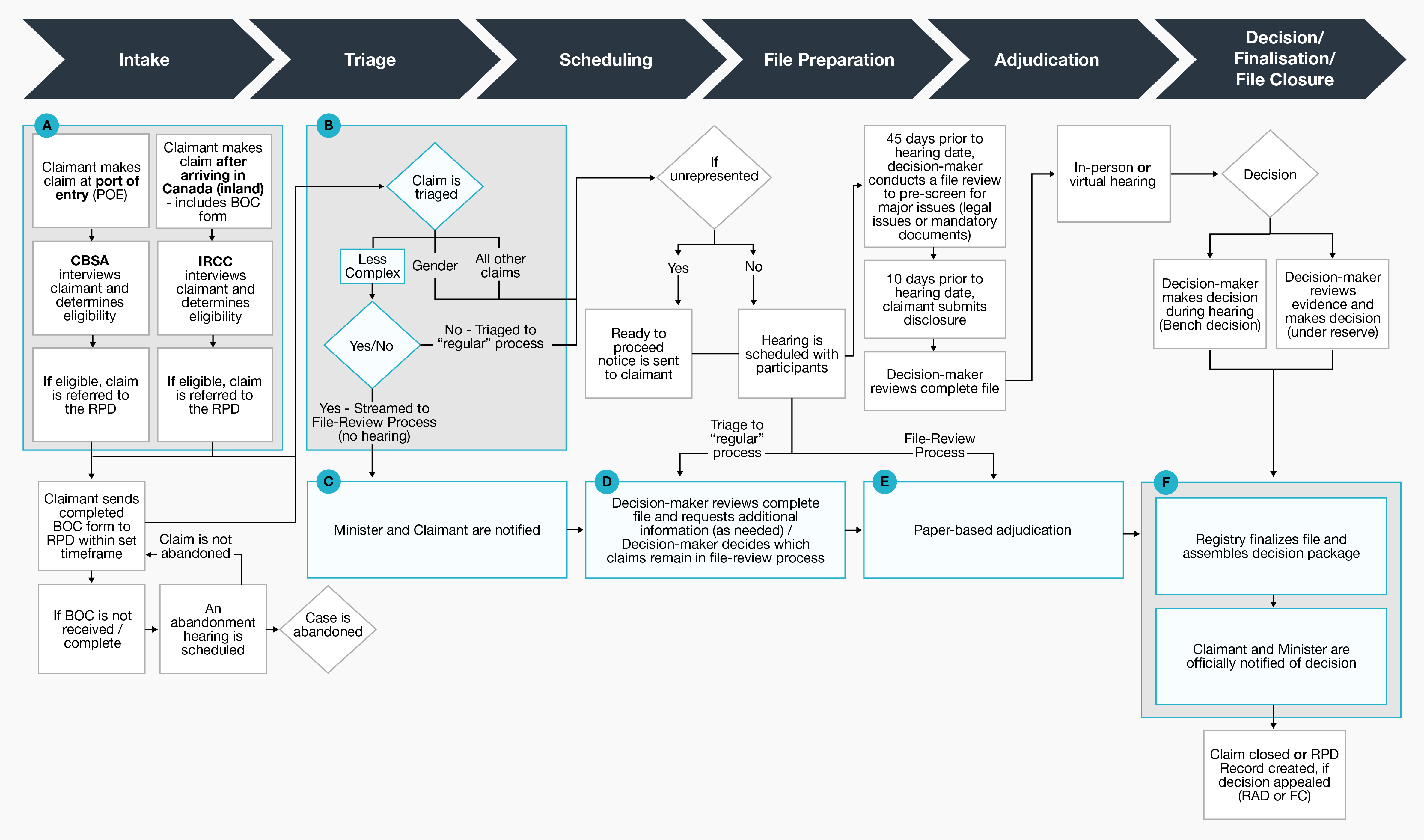
Text version
Refugee Protection Division (RPD) Operational Procedure
Process for all claims
Note that steps 1 and 2 apply to all claims, and steps 3-6 split between decisions made as a result of a hearing and the file-review process.
Step 1. Intake
A refugee claim is made:
- At port of entry (POE) with CBSA
or with IRCC after arriving in Canada (in-land claim)
A CBSA or IRCC officer conducts an interview and determines eligibility
Decision: Eligibility
-
If eligible
- Claim is referred to the RPD
-
If not eligible
- Claim is not referred to RPD
Further Details on Referral Process Eligibility
- Before the claim is referred to the IRB, all claimants have an in-person interview with either CBSA or IRCC, where identity documents and biometrics are collected.
- If, after the interview, the claimant is found to be
ineligible on grounds of security, serious criminality, organized criminality, or for violating human or international rights, the claim is
not referred to RPD.
Step 1.5 – Abandonment Sub-Process
Condition: Claim made at POE
- Claimant must submit completed Basis of Claim (BOC) form to the RPD within required timeframe
Decision: BOC completeness
-
If BOC complete
- Claim proceeds to Step 2, triage
-
If BOC not received or is incomplete, the claim is streamed to the abandonment process
- Abandonment hearing scheduled
-
If claim abandoned
-
If claim
not abandoned
- Claimant must submit completed BOC form to RPD within set timeframe
Step 2. Triage
Claim is triaged
Decision: Eligible for File‑Review Process?
-
Yes, streamed for File-Review Process. Claim is streamed to the file-review process (no hearing). See “Process for decisions through the file-review process” section.
-
No, not streamed for File-Review process - Claim is triaged to regular process with a hearing, claim proceeds to step 3 - Scheduling
Further Details on File-Review Criteria
- The IRB has put in place instructionson the streaming of less complex claims for the file-review process at the RPD.
- Claims are not eligible and streamed to the file-review process if:
- the CBSA has not completed FESS
- there are credibility concerns
- identity is not established
- the claim is inconsistent with country information
- there are complex legal or factual issues that require a hearing to resolve
- the RPD notifies IRCC or CBSA of a possible exclusion, inadmissibility or integrity issue or
- the Minister intends to intervene in person.
Process for decisions through a hearing
Step 3. Scheduling
Decision: if claimant is represented or unrepresented
-
If unrepresented, the ready to proceed notice is sent to claimant
- Hearing is scheduled with participants, claim proceeds to step 4 File preparation
-
If represented, hearing is scheduled with participants, claim proceeds to step 4 File preparation
Step 4. File preparation
- 45 days prior to hearing date,
- Decision-maker reviews file to pre-screen for legal issues or mandatory documents
- 10 days before hearing date
- Claimant submits disclosure
- Decision-maker reviews complete file, claim proceeds to step 5 - Adjudication
Step 5. Adjudication
Hearing held (in-person or virtual), claim proceeds to step 6.
Step 6. Decision / Finalisation / File Closure
The decision-maker may:
- Make a decision during hearing (bench decision),
or
- Review evidence and make a written decision
Further Details on Decision-Making Process
- All decision-makers are independent and weigh the evidence on the file and make their decisions in accordance with the law and the instructions.
Once decision made, claim proceeds to finalisation:
- Registry finalizes file and assembles decision package
- Claimant and Minister are officially notified of decision
Outcome
- Claim closed,
or
- RPD record created if decision is appealed:
- to Refugee Appeal Division (RAD),
or
- Judicial review by Federal Court (FC)
Process for decisions through the file-review process
This process would initiate if the decision at Step 2 Triage is to stream to file-review process.
Step 3. Notification of Minister and Claimant
- Once a file is triaged into the file-review process, the Minister is notified and given at least 22 days to decide if they want to intervene in the claim.
- The claimant is also notified. At this stage, additional information may be requested from the claimant to complete the file.
Step 4. Decision-maker review
Decision-maker reviews complete file. Decision-maker decides which claims remains in file-review process.
-
If yes
- Proceed to paper-based adjudication
-
If no
- Redirect to Process for decisions through a hearing, Step 3. Scheduling.
Step 5. Paper-based adjudication
- Decision-maker makes a paper-based decision.
Further Details on Decision-Making Process
All decision-makers are independent and weigh the evidence on the file and make their decisions in accordance with the law and the instructions.
Step 6. Finalisation and File Closure
- Registry finalizes file and assembles decision package.
- Claimant and Minister are officially notified of decision
- Outcome
- Claim closed,
or
- RPD record created if decision is appealed:
- to Refugee Appeal Division (RAD),
or
- Judicial review by Federal Court (FC)
| A | Referral process - eligibility- Before the claim is referred to the IRB, all claimants have an in-person interview with either IRCC or CBSA, where identity documents and biometrics are collected.
- If, after the interview, the claimant is found to be ineligible on grounds of security, serious criminality, organized criminality, or for violating human or international rights, the claim is not referred to RPD.
|
|---|
| B | Triage - file review process- Pursuant to section 170(f) of the IRPA, the IRB has put in place instructions governing the streaming of less complex claims at the RPD.
- Once a claim is referred to the IRB, it is triaged into the file-review process if it meets the criteria set out in the instructions.
- Claims are not eligible for the file-review process if:
- the CBSA has not completed FESS;
- there are credibility concerns;
- identity is not established;
- the claim is inconsistent with country information;
- there are complex legal or factual issues that require a hearing to resolve;
- the RPD notifies IRCC or CBSA of a possible exclusion, inadmissibility or integrity issue; or
- the Minister intends to intervene in person.
|
|---|
| C | Notification of Minister and claimant- Once a file is triaged into the file-review process, the Minister is notified and given at least 22 days to decide if they want to intervene in the claim.
- The claimant is also notified. At this stage, additional information may be requested from the claimant to complete the file.
|
|---|
| D | Decision-maker review- The decision-maker will review the complete file and decide which claims will remain in the file-review process.
- On average, 60% of claims initially triaged in file-review process are streamed back to a full hearing (40% remain in the file-review process).
|
|---|
| E | Adjudication- A decision-maker will make a paper-based decision.
- All decision-makers are independent and weigh the evidence on the file and make their decisions in accordance with the law and the instructions.
|
|---|
| F | Decision & file closure- Decision is communicated to the claimant and the Minister.
- Decisions can be appealed to the RAD or judicially reviewed by the Federal Court.
|
|---|
F. File Review Factual Corrections
Statement made | Initial comments | Secondary comments |
|---|
The file review policy involves the rapid acceptance of asylum claims without conducting a hearing or asking any questions of the claimant. For example, between January of 2019 and February 2023, the IRB accepted 24,599 asylum claimants into Canada without asking them a single question. | -
Paper-based and automated decision-making is in place across the immigration system.
- 24.6K represents 14% of the total finalizations for the period (176.5K).
- A visa holder is screened before arrival in Canada
- A person is seen at the border by a CBSA officer
- If making a claim at the border, the person is interviewed
- If making a claim from inside the country, the person was already seen at the border and is then interviewed by IRCC
- To apply for refugee protection, you are required to answer many questions and provide evidence
| - Period included the pandemic months before full business resumption, when due to sanitary restrictions, fewer decisions through a hearing were rendered until a virtual system was put in place.
|
The policy did not work because the backlog increased from approximately 17,000 claims in 2016 to approximately 300,000 in 2025, an increase of more than 1,400% | - The IRB has no control over how many claims are referred to the RPD for determination.
- The increase in the RPD backlog is not evidence that file review is ineffective.
- Many factors contributed to the backlog: changes in US immigration policy, worsening human rights globally, and people already in Canada losing status in large numbers.
- It was never intended as a backlog-elimination strategy. Backlogs result from intake and capacity imbalances, not from procedural streamlining tools alone.
| - The file-review process that can lead to a paper-based decision is not a recent policy approach.
- Parliament has authorized “acceptance of claims without a hearing” under the (former)
Immigration Act since 1993, and this authority has been preserved through successive legislative reforms, including under the (current)
Immigration and Refugee Protection Act through which the IRB derives all of its authorities. The IRB has consistently had a paper-based decision-making process in place since 1993 pursuant to these authorities.
- File review was introduced as a productivity and efficiency triage mechanism to resolve straightforward cases without a full hearing.
- An adjudicative body alone such as the IRB cannot eliminate backlog if intake persistently exceeds capacity; other factors to consider include:
- Predictable funding to ensure sufficient capacity, and,
- Complementary policies that manage access to Canada.
|
The policy increases risk to Canada because hearings serve as a screening mechanism for security and fraud concerns. | - The primary responsibility for security screening rests with the Minister of Public Safety.
- Claimants are interviewed and screened before their files are referred to the RPD.
- Section 170(f) of the
Immigration and Refugee Protection Act (IRPA) expressly authorizes the RPD to accept a claim without a hearing. The only restriction in the IRPA on this authority is that the RPD cannot accept a claim without a hearing where the Minister intervenes within the time limit set out in the RPD Rules.
- The Chairperson’s “Instructions governing the streaming of less complex claims at the Refugee Protection Division” (January 29, 2019) include several additional criteria which act as additional safeguards over and above what is included in the IRB’s controlling legislation, the IRPA.
| - The IRB operates within a broader system that includes screening processes and safeguards to protect the integrity of Canada’s refugee system.
- Under the file review process, if credibility, exclusion, fraud or security concerns arise, the matter is referred to a hearing.
- Files that proceed to file review do not include any issues that would be questioned in a hearing.
- File review is barred if:
- the CBSA has not completed FESS;
- there are credibility concerns;
- identity has not been established;
- the claim is inconsistent with country information;
- there are complex legal or factual issues that require a hearing to resolve;
- the RPD has notified IRCC or CBSA of a possible exclusion, inadmissibility or integrity issue; or
- the Minister intends to intervene in person.
|
If questioning raises a red flag, the IRB member must stop the hearing and notify the Minister;
If the IRB is accepting claims without conducting hearings or asking any questions, those risks will never be detected;
The IRB’s File Review Policy nullifies the Minister’s ability to intervene. | - The Policy does not affect the Minister’s statutory right to intervene.
- The Minister is afforded the opportunity at any stage up until the delivery of the decision to intervene.
- If information arises suggesting, for example, exclusion, misrepresentation, organized criminality, or security concerns, the matter can be converted to a hearing and notice is provided to the Minister.
| - File review under Section 170(f) of the IRPA only applies where the Minister has chosen not to intervene within the prescribed time limit.
- Prior to the hearing, under RPD Rules 26-28 the RPD member must notify the Minister if there is a possibility that Exclusion under Article 1E or 1F of the 1951 Refugee Convention applies, or if there are concerns related to system integrity or inadmissibility, or if the claimant may not be eligible to have a claim referred to the RPD.
- Once the hearing begins, notification of the Minister is optional for all concerns other than eligibility. The Minister can intervene in-person or through written representations at any point during the refugee process
- The Minister can appeal a decision to the RAD.
|
The policy interferes with Board members’ ability to freely assess evidence, contrary to principles of administrative law, by imposing a mandatory file triage structure | - The Chairperson’s Instructions are lawful “soft law” instruments that guide process but do not dictate outcomes.
- Members retain discretion to remove files from file review and convene a hearing where appropriate, consistent with the Federal Court of Appeal decision in
Thamotharem and established administrative law principles.
- The freedom of members to act independently and screen files out is explicitly set out in the Instructions and is demonstrated by the large number of files that are screened out.
- In 2025, 60% of claims were ultimately streamed out of the file review and short hearing processes, demonstrating that members do not treat triage recommendations as binding and continue to exercise independent judgment.
| - File review is discretionary: members are not compelled to accept a triage recommendation. The member must independently review the evidence before them before making a decision.
- The IRB Chairperson has the authority to take any action that may be necessary to ensure that the members of the Board carry out their duties efficiently and without undue delay (s. 159(1)(g) of IRPA).
- The Federal Court has further consistently affirmed that tribunals may adopt efficiency-enhancing procedures provided individual members retain decisional independence.
|
The policy relies on assessments by individuals other than the decision‑maker, pressuring members into fast positive decisions.
Persons other than the person with authority delegated by Parliament are assessing the evidence in each file and making implied recommendations to adjudicators. This interferes with the independent assessment of the evidence in their files and pressures board members into making fast, positive decisions without asking questions. | - Triage is an administrative sorting function, not a determinative or binding recommendation.
- Decision makers retain full authority to assess evidence and reach independent conclusions.
- Treating triage as outcome determinative mischaracterizes its role and incorrectly implies fettering.
- The Instructions explicitly state that members make the final determination, as in past policies.
- IRB staff has been involved for over 25 years in providing recommendations to members regarding whether to accept claims without a hearing.
- Jurisprudence has recognized that such recommendations are non-binding on the member (e.g.,
Neupane, 2010 FC 1237;
Arunachalan, 2002 FCA 265).
| - The Instructions state that:
- The Instructions further state that:
The RPD may, at any time, remove a claim from the file-review or short-hearing process. For example, this will occur if it becomes clear in the course of processing that the claim is more complex than it originally appeared.
- The Instructions are not a mechanism by which staff can compel a positive outcome; they are a tool intended to address productivity and fairness, not direct members to reach a given conclusion. Throughout the process, the member must independently review the evidence.
|
The IRB implemented the policy without consulting the Minister or Parliament. | - Parliament has already authorized acceptance without a hearing through section 170(f) of the IRPA and has repeatedly preserved this authority since 1993 throughout various amendments to the asylum regime.
- No statutory requirement exists for Ministerial or Parliamentary approval of internal procedural instructions issued under the Chairperson’s express supervisory powers set out in section 159 of the IRPA.
| - The current Instructions, which updated the IRB’s 2015
Expedited Policy, were issued in January 2019.
- The IRB has statutory authority under IRPA to control its own procedures, subject to regulations.
- The Asylum System Management Board (ASMB) was established in 2018 at the Deputy Minister level to govern and coordinate operationally between CBSA, IRCC and IRB, chaired by IRCC.
- ASMB was engaged on the development of the task force on less complex claims between November 2018 and May 2019.
- A draft of the Instructions with a request for feedback was circulated for comment to stakeholders, including IRCC and CBSA, in November 2018 prior to the Instructions being finalized.
- The acting DM IRCC confirmed support for the measures set out in the OAG’s Spring 2019 Report 2: Processing of Asylum Claims (recommendation/response below) in her opening remarks to Public Accounts Committee on the OAG Audit.
- In May 2025, coordination for the program was continued at the ASMB with partners confirming that approximately 11,000 cases were ready and referred to the RPD for TFLCC.
|
As an administrative tribunal, the IRB lacks authority to implement policies implicating the Minister of Public Safety’s mandate. | - The Instructions fall squarely within the Chairperson’s statutory authority under ss. 159 and 162 of the IRPA to manage proceedings efficiently.
- They do not intrude on the Minister’s mandate, which is preserved through the intervention framework established by Parliament.
| - The IRB does not alter the Minister’s mandate through its procedural decisions on operationalizing workload and case management.
- Public Safety retains responsibility for enforcement.
|
In the UK, France, New Zealand, and Australia similar changes require parliamentary approval, revealing a structural problem – he asserts the IRB is too independent and should report to a Minister.
I think this may point to a structural problem with Canada's model. Canada's IRB may be too independent. It reports to no Minister. For that reason, it can't be seen clearly, and its actions cannot be predicted | - Canadian refugee procedure is governed by domestic statute, which explicitly authorizes acceptance without a hearing.
| - Comparative systems vary significantly, and comparisons must consider structural differences.
- Canada’s model was deliberately designed to:
- Separate refugee determination from enforcement
- Comply with Charter requirements
|
More broadly, the IRB's acceptance rate, or recognition rate, has now increased to 80% of claims decided on the merits, excluding claims that are withdrawn or abandoned. He compares Canada’s acceptance rate to those of Ireland (30%), Sweden (40%), and Germany (59%) in 2024 | - Difficult to compare: Europe has very few legal pathways for migration for persons outside the European Union
- Europe has experienced successive waves of economic migration from Africa and the Middle East that look to the asylum system to regularize their stay in the European Union
- By contrast, Canada’s asylum system is one avenue of many pathways for potential migrants
- As a result, we have different caseload in Canada.
- Our legal context is also distinct in how refugee convention and subsidiary protection is assessed.
-
To compare Germany as an example:
- 162K claims in 2025
- 54,000 (1/3) were repeat claimants – not eligible in Canada - and for which the success rate is very low
- Top country for Germany: Afghanistan (ranks 33rd in Canada)
- In 2024, positive claim rate is 93% for Afghanis in Germany vs. a 95% acceptance rate in Canada in 2025
| - Acceptance rates are not reliable comparative indicators without context as they can vary depending on:
- Source countries
- Other residency pathways available
- Types of claims
- Designated country policies
- Jurisprudence on key elements of protection
- Canada’s system includes Convention refugee and protected person grounds (risk to life, risk of torture, cruel and unusual treatment or punishment.).
- European jurisdictions have historically taken a narrower approach to subsidiary protection.
- Europe allows repeat claims which represent a high proportion of claims, and which are overwhelmingly negative.
|
That the file review policy be ended and return to regular in-person refugee hearings | - The file-review process is one way that the RPD responsibly case manages its inventory in an efficient manner in accordance with its mandate under section 162.
- Repeal of the authority under section 170(f) to accept claims without a hearing would impact on the RPD’s overall efficiency.
| - For
prima facie protection cases/manifestly founded claims supported by objective evidence and no credibility issues, a full hearing may add delay without improving fairness.
- The IRB has a long history of exploring expedited processes for straightforward cases, and efficiency mechanisms can be implemented while maintaining fairness if safeguards are preserved.
- Eliminating the file review process could risk:
- Increasing hearing volume pressure
- Lengthening wait times for vulnerable claimants
- Reallocating resources away from complex cases
- Potentially increasing overall backlog.
- Creating impacts across the asylum system, including driving up Interim Federal Health Program costs, slowing down removal of failed claimants, etc.
|
Ministers and cabinet should assume responsibility for asylum policy and the functions of the RPD be placed under Ministerial supervision while maintaining independence, as was an option in the Yeates Report. | - We cannot comment on policy, including whether as a policy matter, other models of asylum system should be considered.
- However, with respect to the Yeates Report, it should be pointed out that Mr. Yeates recommended expansion of the file-review process (called expedited process at the time).
| - The Yeates Report recommended that:
-
(Recommendation 25) Common triage should be used to stream cases to decision based on complexity and by quality of the claim, whether a hearing is required or not, ensuring that cases are streamed to specialized decision makers which may specialise by groups of similar countries, specific countries or types of claims
-
(Recommendation 26) Paper-based decision making should be considered in as many cases as feasible
- The government could consider a number of alternate operating models, including an Integrated Model that would place the whole protection-related federal mandate within a Refugee Protection Agency reporting to the Minister of IRCC, merging protection programs in one integrated Agency. As in the proposed Systems Reform Model, front-end processes would be integrated and streamlined to reduce redundancy and duplication. All first-level protection decision making, whether in Canada or abroad, would be entrusted to one agency reporting to the Minister of IRCC. This includes the registration, screening and triages of claims. Security and intervention functions would remain under the Minister of Public Safety though opportunities exist to explore improvements to front-end processing at ports of entry. Appeals would remain separate in an administrative tribunal alongside the Immigration Appeal Division at the IRB.
|
G.
Immigration and Refugee Protection Act – Claim for Refugee Protection
99(3) A claim for refugee protection made by a person inside Canada
must be made in person to
an officer, must not be made by a person who is subject to a removal order and is governed by this Part (Part 2 of the Act)
100(1) An officer shall, after receipt of a claim referred to in subsection 99(3),
determine whether the claim is eligible to be referred to the Refugee Protection Division and, if it is eligible, shall refer the claim in accordance with the rules of the Board.
- The burden of proving that a claim is eligible to be referred to the RPD rests on the claimant, who must answer truthfully all questions put to them.
101 (1) A claim is ineligible to be referred to the RPD, if
- (a) Refugee protection has been conferred on the claimant under this Act
- (b) A claim for refugee protection by the claimant has been rejected by the Board;
- (c) A prior claim by the claimant was determined to be ineligible to be referred to the RPD, or to have been withdrawn or abandoned
- (c.1) the claimant has, before making a claim for refugee protection in Canada, made a claim for refugee protection to a country other than Canada, and the fact of its having been made has been confirmed …
- (d) the claimant has been recognized as a Convention refugee by a country other than Canada and can be sent or returned to that country;
- (e) the claimant came directly or indirectly to Canada from a country designated by the regulations, …
-
(f) the claimant has been determined to be inadmissible on grounds of security, violating human or international rights, serious criminality or organized criminality
103(1) Proceedings of the RPD in respect of a claim for refugee protection
are suspended on
notice by an officer that
- (a)
The matter has been referred to the ID to determine whether the claimant is inadmissible on grounds of security, violating human or international rights, serious criminality or organized criminality; or
- (b) An officer considers it necessary to wait for a decision of a court with respect to a claimant who is charged with an offence under an Act of Parliament that may be punished by a at least 10 years.
104 (1) An officer may, with respect to a claim that is before the Refugee Protection Division or, in the case of paragraph (a.1) or (d), that is before or has been determined by the Refugee Protection Division or the Refugee Appeal Division,
give notice that an officer has determined that
-
(a) the claim is ineligible under paragraphs 101(1)(a) to (e), other than paragraph 101(1)(c.1);
-
(a.1) the claim is ineligible under paragraph 101(1)(c.1);
-
(b) the claim is ineligible under paragraph 101(1)(f);
-
(c) the claim was referred as a result of directly or indirectly misrepresenting or withholding material facts relating to a relevant matter and that the claim was not otherwise eligible to be referred to that Division; or
-
(d) the claim is not the first claim that was received by an officer in respect of the claimant.
104(2) A notice given under those provisions has the
following effect:
- (a)
Terminates pending proceedings (before the RPD [and some before the RAD])
- (b) If not the first claim,
it terminates the proceedings and nullifies any other decision (RPD – RAD)
170. The RPD, in any proceedings before it,
- (b) must hold a hearing
- (f) may, despite paragraph (b), allow a claim for refugee protection without a hearing, if the Minister has not notified the Division, within the period set out in the rules of the Board, of the Minister’s intention to intervene;
- (h) may receive and base a decision on evidence that is adduced in the proceedings and considered credible or trustworthy in the circumstances,
- (i) may take notice of any facts that may be judicially noticed, any other generally recognized facts and any information or opinion that is within its specialized knowledge
162 (2) Each Division shall deal with all proceedings before it as
informally and quickly as the circumstances and the considerations of fairness and natural justice permit.
164 Where a hearing is held by a Division, it may, in the Division’s discretion, be conducted in the presence of, or by means
of live telecommunication with, the person who is the subject of the proceedings.
H. 2019 Office of the Auditor General Audit
- The 2019 Auditor General audit (OAG Audit) identified structural inefficiencies, limited case triage and under-utilization of authorities to process straightforward refugee claims without a full oral hearing.
- On May 7th, 2019, the OAG tabled a report on the Processing of Asylum Claims by the CBSA, IRCC and the IRB. The Audit had three main findings:
- Canada’s refugee determination system was
not equipped to process claims according to the required timelines.
- A
series of inefficiencies contributed to delays in processing claims (e.g., significant gaps in information sharing and duplication of effort among the three main organizations involved in the claims process (CBSA, IRCC and IRB)).
- Hearings for almost two thirds of claims were postponed. Most of these postponements were due to issues that were within the government’s control and resulted in delays of several months.
- The OAG recommended that the IRB should make better and more frequent use of the processes at its disposal to
expedite protection decisions for eligible asylum claimants (paragraph 2.48).
- In response to the OAG Audit, at the May 28, 2019 Standing Committee on Public Accounts, former A/DM of Immigration, Refugees and Citizenship, Lori MacDonald, noted:
- that the system needs to be better managed and properly equipped to respond.
- that IRCC agrees with all Auditor General recommendations and is working with partners to make the system faster, more efficient, and fair.
I. System Integrity
Key messages
- CBSA and IRCC have the primary responsibility of ensuring the integrity of the in-Canada Asylum system.
- The IRB plays an important role in supporting the integrity of the immigration and asylum continuum.
- Adult refugee cases do not proceed to hearing without the completion of the front-end security screening by CBSA and security partners.
- The IRB routinely notifies the CBSA and IRCC in cases where an intervention should be considered in refugee cases.
- The IRB’s case management strategies also support the integrity of the asylum system, prioritizing cases where the Minister is seeking to intervene.
- For detention cases, the onus is on the Minister’s counsel to bring forward the case against the person to justify the case for continuing detention.
- Specialized support is provided for decision-makers, such as training, case management tools and research functions, all supporting fair, transparent and well-reasoned decision-making.
- Asylum hearings are inquisitorial with onus on the claimant to satisfy the threshold for well-founded fear through evidence and testimony.
- Minister’s counsel is afforded the opportunity to present adverse or contrary information.
- The
Minister intervenes in about 7% of total cases and the IRB prioritizes these for hearing. This figure is further broken down:
- The Minister proactively intervenes in 5% of total cases.
- The Minster intervenes in an additional 2% of total cases where the IRB notified the Minister.
- Refugee Appeals, cessation or vacation hearings provide additional avenues for the Minister to argue that protection is no longer merited or where the person misrepresented their case.
- The IRB also employs case management strategies to support the integrity of the asylum system, including short processes for:
- Cases that appear to be abandoned by the claimant.
- Straightforward cases (e.g., TFLCC) allows focus of resources on more difficult ones.
- The IRB also addresses integrity by acting in response to conduct issues by counsel. This includes leveraging mechanisms to ensure due process of proceedings such as the Rezaei process for egregious behaviour from authorized counsel.
- While the powers of an adjudicator are broad powers of inquiry, the RPD hearing was established as an inquisitorial process. Members can ask any question that may be relevant to adjudicating the claim including on exclusions.
Key Integrity Issues
Similar Bases of Claims (BOCs)
- IRCC and CBSA investigate where groups of cases have similar or the same basis of claim (BOC) narratives, indicating potential fraud or counsel misconduct.
- Recently, the Federal Court allowed the judicial review and overturned the negative RAD decision in a similar BOC case where the Minister had argued similar BOCs at the Refugee Appeal Division. The Court confirmed a high standard needs to be met to establish that a similar BOC is fraudulent.
- The IRB has mechanisms in place to address instances of similar basis of claim or documentary evidence - whether raised by the Minister via intervention or internally by the member.
- Where raised internally, there is a clear process to notify and disclose to IRCC/CBSA for further investigation.
Notices to the Minister
- Should issues of exclusion or integrity arise in a claim where no intervention has been filed, the RPD notifies the Minister.
- A Notice to the Minister provides the Minister with an opportunity to review the issues and determine whether to intervene in the claim.
- This process is spelled out in the IRPA, to maintain the integrity of the Canadian refugee protection system, the security of Canadian society and to promote international justice.
- Some common examples of when the RPD would send a Notice to the Minister include:
- Exclusion – if there is information in the file that the claimant committed a serious, non-political crime before coming to Canada, committed crime against peace, war crime or crime against humanity, or had a status in a third country similar to a national of that country.
- Integrity/Credibility – if the claimant makes substantial amendments to the BOC Form or it appears that the claimant submitted a fraudulent document.
- The CBSA and IRCC intervene in approximately 6% of all claims, on average. Approximately two-thirds of those interventions are initiated by the Minister, and one third are initiated in response to Notices to the Minister sent by the IRB.
J. Bill C-12 - Impact on IRB Operations
Highlights of Bill C-12 for the IRB
-
New grounds of ineligibility: Bill C-12 adds two (2) new grounds of ineligibility to have a claim referred to the RPD:
- Individuals are ineligible if the claim was made 14 or more days after the claimant entered Canada irregularly between Canada-U.S. border crossings;
- Individuals are ineligible if the claim was made on or after June 3, 2025, and if claim was made more than one year after date of entry (after the claimant’s first arrival after June 24, 2020).
Individuals affected by these two new ineligibility grounds will be redirected into the Pre-Removal Risk Assessment (PRRA) system.
-
Consideration of claims prior to referral (Ministerial Due Diligence (MDD) prior to referral to the IRB): With Bill C-12, if an officer determines that the claim is eligible to be referred to the RPD, the Minister must consider it further within a time limit prescribed in the Regulations. The Minister receives documents and information from the claimant and therefore has an opportunity to perform MDD prior to referring the claim to the IRB. Given the prescribed time limit, there is uncertainty whether all claims will undergo complete MDD prior to referral to the IRB.
-
Documents and information to be provided by claimants (single online application): Under the proposed new process, the claimant must, within the time limits provided for in the regulations and in the manner specified by the Minister, provide the Minister with the documents and information specified by the Minister and the documents and information required by the rules of the Board. This new process applies both to port of entry and to inland claims.
-
Abandonment before claim is referred to the RPD (pre-referral abandonment): Under a new provision, if a claimant fails to provide documents or information or fails to appear for an examination before the claim is referred to the RPD, the Minister must “transmit” the claim to the RPD to determine whether the claim was abandoned. The RPD cannot compel the Minister, an officer or any other person who is authorized to act on the Minister’s behalf, to appear for an abandonment hearing.
-
Chairperson’s power to specify the “manner” of reasons and decisions: The amendment clarifies that the Chairperson may specify the “manner” in which decisions must be rendered and reasons for decisions must be given. Members remain independent decision-makers, but this provision permits the Chairperson, for example, to require members to use electronic tools such as templates when preparing reasons for decision.
-
Requirement that person be “physically present in Canada”: Bill C-12 amends the IRPA to provide that the RPD, the RAD, and the ID may proceed only if the subject of the proceeding is physically present in Canada. The RPD or RAD must consider a claim or appeal to be abandoned if the claimant or appellant voluntarily returns to the country that they said they needed protection from, and the RPD or RAD has not yet decided their claim or appeal
K. Pre-Removal Risk Assessment
Key Messages
- Pre-Removal Risk Assessment (PRRA) decision-makers at IRCC conduct first-level protection decisions through a paper-based process, though where credibility is at issue an interview is required (per SCC
Singh decision).
- Allows individuals in Canada with an in-force removal order to apply to the Minister for protection on the same grounds as before the RPD, with some exceptions, such as if the person is inadmissible. In those cases, the person is offered a “restricted PRRA.”
- Failed asylum claimants may make a PRRA application if removal is not executed within one year of the last decision based. In those cases, PRRA applicants are restricted to presenting new evidence.
- Similar decisions but PRRA is only triggered when removal is planned.
- PRRA was to transfer to IRB as part of 2010 Refugee Reform. The 2010 and 2012 IRPA amendment never came into force and was repealed in 2022.
L. Refugee Protection Division – Key Facts
Key Messages
- Fiscal year to date (to December 31, 2025), the RPD finalized over 59,800 cases, with a published target for the fiscal year of 80,000 finalizations.
- During the same period, the RPD received approximately 75,500 asylum claim referrals, a decrease in referrals of 45% compared to the period of April to December 2024 (143,600 claims).
- As of December 31, 2025,
- inventory of 182,800 claims (61%) that are ready to be heard.
- A further 117,300 claims (39%) are incomplete due to a pending security screening and/or other outstanding requirement.
- The acceptance rate for the first nine months of FY 2025-26 was 63%, which is aligned with the average of the past five years of 63%. Fluctuations occur over time due to volume of intake by country and type of claims received.
- As of December 31st, 2025, the RPD inventory was comprised of more than 300,100 claims, representing a wait time of 40 months of work at the RPD’s funded capacity for 2026-27 of 90,000 claims per year.
- We continue to perform above funded levels.
Key statistics
-
Status: As of December 31, 2025, about 39% of the current inventory of refugee claims were not ready for scheduling, which means they cannot proceed to a hearing and finalization due to a pending security screening and / or other outstanding requirements.
-
Age: 39% of pending claims were less than 1 year old (received in 2025.)
- 46% of cases were received in 2024.
- 15% of cases were received in or prior to January 2024.
- Average wait time for a decision at the RPD at the end of December 2025 was 24 months from the time of referral and 17 months from the time a claim is ready for adjudication:
All Claims
|
Inventory Composition by Age of Claims |
Total Volumes |
Total Proportion |
|---|
< 12 months | 116,200 | 39% |
1-2 years | 138,400 | 46% |
2+ years | 45,500 | 15% |
Total | 300,100 | 100% |
Country Make-up
|
Top countries for asylum claims in RPD Inventory |
Total Claims Pending (rounded) |
% of Inventory |
Acceptance Rate in 2025-26
(April to December 2025 inclusively) |
|---|
Top 10 Countries |
192,200 |
64% |
57% |
India | 45,700 | 15% | 25% |
Haiti | 29,400 | 10% | 71% |
Mexico | 24,100 | 8% | 39% |
Nigeria | 21,600 | 7% | 68% |
Bangladesh | 20,100 | 7% | 45% |
Sri Lanka | 12,600 | 4% | 70% |
Iran | 11,500 | 4% | 71% |
Ghana | 9,800 | 3% | 63% |
Pakistan | 8,700 | 3% | 78% |
Colombia | 8,700 | 3% | 68% |
Other 178 Countries |
107,900 |
36% |
71% |
Total | 300,100 | 100% | 63% |
M. Refugee Protection Division – Processing and Wait Times
Key Messages
- As of December 31, 2025:
- Claims decided take
24 months from referral to decision
-
once they were ready for adjudication: 17 months
- FESS + frontend processes take
7 months on avg.
- Last fiscal year, the IRB issues 78,700 decisions, an increase in 42% from the previous year’s output of 55,300 decisions.
- IRB’s funded capacity for RPD was 60,000 in FY2024-25 (57,500 of funded capacity and 2,500 in commitment of efficiency gains).
- With recent intake higher than IRB’s funded capacity, and despite significant investments in productivity,
wait times will continue to grow – it sits at a little less than 300,000 cases today.
Background
- As of December 31, 2025, the RPD inventory was comprised of more than 300,100 claims, representing
40 months of work at the
RPD’s funded capacity for 2026-27 of 90,000 claims per year.
- Approximately 39% of this inventory (117,300 claims) were awaiting documents from external parties or the claimant before the claim can be scheduled for adjudication.
- The implementation of the Horizon 2026-27 initiatives has supported an increase in RPD claims finalizations from 78,700 in 2024-25 to a projected 85,000 in 2025-26.
-
Budget 2025 will increase output to 90,000 in 26/27 and higher in 27/28.
- While the IRB workforce has grown 156% since FY 2025/26, during the same period, asylum decision output has grown by over 417% and asylum claims intake has grown by 921%.
- Growth in asylum decisions output: 15,200 decisions rendered by the RPD in 2015-2016 and 78,700 decisions rendered by the RPD in 2024-25 = a growth of 417%.
- Growth in asylum claims input: 16,700 claims received at the RPD in 2015-2016 and 170,500 claims received at the RPD in 2024-25 = a growth of 921%.
N. Acceptance Rates
Global acceptance rates by calendar years
|
Year |
Acceptance Rates |
|---|
| 2025 | 62% |
| 2024 | 62% |
| 2023Note 2 | 70% |
| 2022 | 60% |
| 2021 | 61% |
| 2020 | 61% |
| 2019 | 57% |
| 2018 | 52% |
| 2017 | 61% |
| 2016 | 61% |
| 2015 | 57% |
Comparing European Acceptance Rates to Canada
- Difficult to compare: Europe has very few legal pathways for migration for persons outside the European Union
- Europe has experienced successive waves of economic migration from Africa and the Middle East that look to the asylum system to regularize their stay in the European Union
- By contrast, Canada’s asylum system is one avenue of many pathways for potential migrants
- As a result, we have a different caseload in Canada.
- Our legal context is also distinct in how refugee convention and subsidiary protection is assessed.
-
To compare Germany as an example:
- 162K claims in 2025.
- 54,000 (1/3) were repeat claimants – not eligible in Canada - and for which the success rate is very low.
- Top country for Germany: Afghanistan (ranks 33rd in Canada).
- In 2024, positive claim rate is 93% for Afghanis in Germany vs. a 95% acceptance rate in Canada in 2025.
O. Refugee Appeal Division – Key Facts
Key Messages
- Last fiscal year the Refugee Appeal Division (RAD) rendered
9,400 decisions.
- In the first nine months of the fiscal year (FY) 2025-26 (April to December 2025 inclusively), the RAD finalized approximately
8,000 appeals.
- 28% of appeals decided were allowed, while 71% were dismissed, and 1% were withdrawn or administratively closed.
- For the same period, approximately 1,580 applications for leave contesting RAD decisions were submitted to the Federal Court.
- The Federal Court granted approximately 70 applications for leave and overturned approximately 45 RAD decisions, representing less than 1% of the decisions rendered at the RAD for the period.
- As of the end of December 2025, the average wait time for a decision from the time the appeal was filed was 4 months.
Inventory
-
Scope: At the end of December 2025, the RAD inventory was comprised of approximately 4,700 appeals, up 42% in 12 months and about 55% down from its peak of 10,400 in September 2019.
All Appeals Source Country |
Total Appeals Pending as of December 31 2025 |
% of Inventory |
Acceptance Rate in 2025-2026
(Q1 and Q3 inclusively)Note 3 |
|---|
Top 10 Countries |
3,130 |
67% |
26% |
India | 880 | 19% | 23% |
Nigeria | 510 | 11% | 24% |
Mexico | 510 | 11% | 29% |
Bangladesh | 400 | 9% | 27% |
Pakistan | 160 | 3% | 31% |
Ghana | 150 | 3% | 22% |
Colombia | 150 | 3% | 26% |
Kenya | 130 | 3% | 32% |
Congo, Democratic Republic of the | 130 | 3% | 27% |
Senegal | 110 | 2% | 36% |
Other 102 Countries |
1,560 |
33% |
29% |
P. Immigration Division – Key Facts
Key Messages
- Last fiscal year (FY 2024-25) the Immigration Division (ID) rendered 10,400 decisions: 8,300 Detention Reviews and 2,100 Admissibility hearings.
- In the first nine months of the fiscal year (FY) 2025-26 (April to December 2025 inclusively), the ID finalized approximately
5,300 detention reviews and
1,660 admissibility hearings.
- The target for 2025-26 for admissibility hearings is at least 1,200 and at least 9,000 for detention reviews.
- ID is experiencing an upward intake trend in admissibility hearings of 35% over the past 3 years (from 1,600 in the 2023 to 2,200 in 2025). We continue to monitor this trend closely.
- In the first nine months FY 2025-26, 80% of admissibility hearings were conducted within 4 months.
- Detention reviews in the first nine months of FY 2025-26
- 98% of more than 5,300 detention reviews were concluded within legislative requirements (target of no less than 96%).
- 15 persons were detained for 180 days or more at any point during the first nine months of the fiscal year.
- No minors were detained during the first 9 months of the fiscal year.
Q. Immigration Appeal Division – Key Facts
Key Messages
- Last fiscal year, the Immigration Appeal Division (IAD) rendered 4,000 decisions.
- In the first nine months of fiscal year (FY) 2025-26 (April to December 2025 inclusively), the IAD decided on approximately
3,100 cases, exceeding the target of at least 3,000 appeals for the fiscal year.
- IAD is experiencing an upward intake trend of 45% over the past 3 years (from 3,200 cases in 2023 to 4,700 in 2025). We continue to monitor this trend closely.
- Until this year, IAD finalizations have historically surpassed or matched intake for the past 11 years.
- The average wait time for a decision at the IAD as of the end of December is approximately 6 months.
- In the first nine months of FY 2025-26, 38% of appeals decided were allowed, while 35% were dismissed.
- The abandonment and withdrawal rates remained stable year-over-year at around 7% for abandonments and 20% for withdrawals.
R. Annex A: Committee Information
About the committee
Committee mandate
The Standing Committee on Citizenship and Immigration (CIMM) studies and reports on all matters relating to the mandate, management and operation of
Immigration, Refugees and Citizenship Canada (IRCC) and the
Immigration and Refugee Board of Canada (IRB).
Motion for this study
That, having regard for the February 23, 2026 National Post article titled, “Overwhelmed by asylum claims, Ottawa coped by ignoring security protocol,” and further to its study on Canada’s Immigration System, the committee invite the Immigration and Refugee Board of Canada to appear before the committee, for two hours, at the earliest opportunity and no later than Wednesday, March 11, 2026.
That, notwithstanding the motion adopted by the committee on Monday, February 23, 2026, to invite representatives of Immigration and Refugee Board to appear before the committee no later than Wednesday, March 11, 2026, representatives of the Department of Citizenship and Immigration and Canada Border Services Agency be also invited to appear along with Immigration and Refugee Board representatives, preferably on March 9, 2026.
About the appearance
Environmental scan
This appearance was prompted by
recent reports in the National Post about IRB’s short hearing and file-review processes used in less complex asylum cases. MPs have shown interest in the rationale, risks, and broader implications of these practices.
The Conservative Party of Canada focused on the asylum system in recent weeks, and have cited the alleged 25,000 claimants approved by IRB without a hearing. The Party has argued failed asylum claimants have access to better healthcare than Canadians through the Interim Federal Health Program (IFHP). They have also advocated for more expeditious removals of failed claimants along with temporary residents holding expired visas.
The Bloc Québecois have raised questions about the alleged 25,000 asylum cases decided without a hearing by IRB. On asylum generally, the Party has disputed CPC claims about IFHP costs incurred by failed claimants. However, they persistently advocate for greater autonomy for Quebec over immigration and for a more equitable distribution of asylum claimants between provinces. The Party argues Quebec is suffering under a disproportionately large asylum burden.
Liberal Party of Canada MPs are customarily supportive of government initiatives but can be expected to pose questions on the rationale for less complex case processes and their implications.
Appearance details
The IRB will deliver a five-minute opening statement, followed by rounds of questioning from committee members. Witnesses will appear for two hours and are listed below:
- Manon Brassard, Chair, IRB
- Roula Eatrides, Deputy Chair, Refugee Protection Division, IRB
- Gary Dukeshire, Senior Counsel, Refugee Protection Division, IRB
- Brett Bush, Director General, Immigration and Asylum Policy, CBSA
- Jason Hollmann, Director General, Asylum, IRCC
- Tal Elharrar, A/Director General, Integrity Policy & Program, IRCC
Membership
| Party | Name and riding | Quick facts |
|---|
|
Conservative Party of Canada |
The Hon. Michelle Rempel Garner Calgary Nose Hill, AB
Vice-Chair of CIMM
Shadow Minister for Citizenship and Immigration | - First elected in 2011.
- Served as Shadow Minister for Immigration, Refugees and Citizenship from November 2015–September 2019, and was the Vice-Chair of CIMM during that time. She was also a member of CIMM from October 2022–September 2023.
- Has regularly expressed concerns about immigration policy across various platforms, with particular focus on temporary immigration and asylum.
|
|
Conservative Party of Canada |
Fred Davies Niagara South, ON Member | - First elected in 2025.
- MP Davies replaces MP Michael Ma on CIMM.
- MP Davies has shown interest in the auto sector, crime, impacts of immigration and asylum seekers on tourism industries
|
|
Conservative Party of Canada |
Costas Menegakis Aurora—Oak Ridges—Richmond Hill, ON Member | - First elected in 2011, defeated in 2015. Returned to Parliament in 2025.
- Served as Parliamentary Secretary to the Minister of Citizenship and Immigration from 2013-2015.
|
|
Conservative Party of Canada |
Brad Redekopp Saskatoon West, SK Member
Associate Shadow Minister for Immigration and Citizenship | - First elected in 2019.
- Served as Vice-Chair of CIMM from 2022-2025 and has been a member of CIMM since 2021.
|
|
Bloc Québécois |
Alexis Deschênes Gaspésie—Les Îles-de-la-Madeleine—Listuguj, QC
Critic for Immigration, Refugees and Citizenship | - First elected in 2025.
- Newly appointed to the role of critic for immigration.
- Former BQ critic for Fisheries and Oceans
- Historically most interested in fisheries and oceans issues. MP Deschênes' priorities on immigration have yet to come into clear focus.
|
|
New Democratic Party |
Jenny Kwan Vancouver East, BC
Critic for Immigration, Refugees, and Housing | *Not currently a member of CIMM* - First elected in 2015.
- Longstanding critic for immigration and former Vice-Chair of CIMM.
- Historically very active on immigration files, with an emphasis on refugees, asylum claimants, undocumented foreign workers and social justice, broadly.
|
|
Liberal Party of Canada |
Julie Dzerowicz Davenport, ON
Chair of CIMM | - First elected in 2015.
- MP Dzerowicz previously served as a member of CIMM from 2016-2017.
- This is her first time serving as chair of a committee.
|
|
Liberal Party of Canada |
Peter Fragiskatos London Centre, ON
Parliamentary Secretary to the Minister of Immigration, Refugees and Citizenship Member | - First elected in 2015.
- MP Fragiskatos held a variety of parliamentary secretary roles prior to his current appointment.
- This is his first time sitting on CIMM.
- Worked in academia before politics.
|
|
Liberal Party of Canada |
Amandeep Sodhi Brampton Centre, ON Member | - First elected in 2025.
- This is MP Sodhi's first time sitting on a committee.
- MP Sodhi is one of the first members of Parliament born in the 21st century.
|
|
Liberal Party of Canada |
Salma Zahid Scarborough Centre—Don Valley East, ON Member | - First elected in 2015.
- Former chair of CIMM and longtime member.
- Record of interest in immigration and advocacy for marginalized populations globally.
|
|
Liberal Party of Canada |
Sameer Zuberi Pierrefonds—Dollard, QC Member | - First elected in 2019.
- Previously served as parliamentary secretary to the Minister of Diversity, Inclusion and Persons with Disabilites.
- First time member of CIMM.
|
Conservative Party of Canada
Top party issues
Since the conclusion of the 2025 federal election, the Conservative Party of Canada (CPC) has been vocal on immigration. The party has regularly linked immigration to housing shortages, health care wait times and unemployment. The Party has recently been especially active on issues involving asylum, including IFHP benefits available to failed asylum claimants, IRB’s practice of “file review” leading to claim approvals with no hearing, and ‘’bogus’’ asylum claimants remaining in Canada.
The CPC has proposed eliminating the Temporary Foreign Worker Program and abolishing birthright citizenship for children of temporary residents. They also sought unsuccessfully to amend Bill C-12 to achieve the below:
- Remove access to federal social benefits for failed asylum claimants, except emergency health care.
- Disallow asylum claims from G7 or EU countries, or persons who transited through a G7/EU country before arriving in Canada.
- Modernize security screening requirements.
- Require educational institutions to share costs of bogus asylum claims made by their international students.
- Automatically abandon claims if the claimant returns to their home country while the claim is pending.
- Reject claims if a claimant is found to have lied to an officer.
- Shift onus to claimants to prove they filed their claim in a timely manner.
- Require claimants to state full grounds for protection immediately on arrival, reducing later manipulation by consultants/lawyers.
- Create a transparent reporting requirement for federal benefits paid to asylum claimants.
- Modernize the Annual Report to Parliament, including expanded data requirements.
- Reform Immigration and Refugee Board appointment processes to better reflect provincial representation and increase merit-based appointments.
Recent party activity
*CPC Immigration Shadow Minister, Michelle Rempel-Garner, posts
about IRCC matters numerous times a day on her
X account.*
- February 26 –
Oral Questions: Said 86% of rejected asylum claimants stay in Canada, 25,000 have been admitted without security screening, and the CBSA has 33,000 non-citizens listed as wanted criminals in Canada (Gladu).
- February 26 –
Oral Questions: Argued IRCC’s Minister is unable to tell the House how many rejected asylum seekers remain in Canada or “how many thousands of people came here without a proper security screening” (Lantsman).
- February 26 –
Oral Questions: Alleged 25,000 asylum seekers have been admitted “without any screenings or checks” (Godin).
- February 23 –
Oral Questions: Contended the government has enabled hundreds of thousands of bogus asylum claims, costing billions (Rempel-Garner).
- February 23 –
Oral Questions: Pointed to a PBO report suggesting the IFHP costs 1.5 billion a year, contended bogus refugee claimants receive benefits not available to Canadians (Mazier).
- February 23 –
Oral Questions: Alleged “health care providers are charging taxpayers up to five times the provincial rates for illegal asylum seekers,” said asylum claimants receive better healthcare than Canadian citizens (Paul-Hus).
- February 23 –
Debates: Argued housing capacity was not aligned
with immigration levels, leading to high home prices (Holman). - February 23 –
X: Suggested bogus asylum claimants receive better healthcare than Canadians and should be deported (Rempel-Garner).
- February 19 –
X: Took issue with a Restaurants Canada graphic in favour of temporary foreign workers, contended the food service industry should train and hire young Canadians instead (Rempel-Garner).
- February 13 –
Oral Questions: Said the “government continue[s] to bring in hundreds of thousands more temporary foreign workers and have no plans to get millions with expired visas to leave,” tied this issue to housing costs (Rempel-Garner).
- February 10 –
Debates: Linked recent reports of extortion in BC to immigration policy, argued the CPC opposition motion would combat crime and better control immigration (Redekopp).
Bloc Québécois
Top party issues
The Bloc Québécois (BQ) is frequently vocal on immigration. The BQ advocates for Quebec to have greater control over immigration. The party has persistently raised concerns about the number of asylum claimants housed in Quebec, which they state is suffering under a disproportionately large burden. They have also argued government measures related to international students and temporary foreign workers impact Quebec negatively.
During the 2025 election campaign, the party made the following commitments:
Temporary foreign workers
- Open sectoral and regional permits for temporary foreign workers.
Border or asylum issues
- Creating a Minister of the Border and implementing stronger border security measures. The BQ intends to introduce a private member’s bill aimed at improving processing times for asylum claims.
French immigration and Quebec
- The BQ is opposed to the Century Initiative and wants Quebec to have full autonomy over immigration.
Settlement and integration
- The BQ has committed to a policy for integrating immigrants into Quebec society. The party would also remove all references to the British monarchy in citizenship ceremonies
Recent party activity
- February 24 –
Debates: Criticized timelines for asylum decisions, suggesting they take forty months. Urged the government to expedite its processing and to issue work permits to asylum claimants more promptly.
- February 24 –
Debates: Spoke in opposition to a CPC motion on failed asylum seekers’ access to healthcare, argued the reasons IFHP costs have increased is due to larger asylum volumes, disputed that IFHP costs are impacting the healthcare available to Canadians, suggested
the motion would increase the burden on provinces (Deschênes). - February 23 –
Debates: Tied housing shortages to high immigration levels, blamed the government (Ste-Marie).
- February 23 –
Oral Questions: Held that the BQ support immigration in principle but the government’s policies have “opened the floodgates” and led to shortages in healthcare, housing, and employment opportunities (Ste-Marie).
- February 23 –
Oral Questions: Pointed unfavourably to a report 25,000 people had been accepted as refugees between 2019-2023 without being interviewed, demanded this practice be halted (Deschênes).
- February 10 –
Debates: Argued repeatedly against a CPC motion barring non-citizens convicted of serious crimes from making refugee claims, with the rationale that such persons are already prevented from making such claims under IRPA (Beaulieu).
- February 2 –
Debates: While delivering remarks in favour of excluding Quebec from the Canadian Multiculturalism Act, contended immigration is the principal lever influencing the future of French in Canada and spoke in support of francophone immigration (Larouche).
- February 2 –
Debates: Alluded to a PBO report saying 25% of the increase in housing costs could be tied to immigration policies (Beaulieu).
- December 11, 2025 –
Debates: Referred to a 2024 Ministerial commitment to more proportionately distribute asylum seekers through the country as a “dog and pony show,” with no concrete results (Brunelle-Duceppe).
- December 10, 2025 –
Debates: Pointed to the BQ’s longstanding concerns about asylum seeker volumes and immigration levels, criticized the other parties for maligning the BQ in the past while now adopting similar positions (Simard).
Liberal Party of Canada
Top party issues
The Liberal Party of Canada (LPC) made the following commitments during the 2025 election campaign:
Refugees
- Supporting legal aid for asylum seekers and refugees and expanding the Rainbow Refugee Assistance Partnership.
Temporary foreign workers
- Capping the total number of temporary workers and international students to less than 5% of Canada’s population by the end of 2027.
Processing times and client service
- Enhancing cooperation between governments, agencies, and organizations for real-time information sharing to improve efficiency and service delivery.
Border or asylum issues
- Planning to strengthen border integrity by increasing resources for security screenings, tightening visa requirements and enhancing enforcement against fraud.
Digitization
- Leveraging digital tools to reduce processing times and eliminate backlogs.
French immigration
- Increasing French immigration outside Quebec to 12% by 2029.
- The LPC leader said it is important to improve the distribution of immigration between provinces.
Levels
- Stabilizing permanent resident admissions at less than 1% of Canada’s population annually beyond 2027 and capping immigration until it can be returned to a sustainable trend
Recent party activity
- February 25 –
Debates: Said the CPC persist in attacking the most vulnerable, specifically refugees and asylum seekers. Argued the CPC have no immigration policy (MacKinnon).
- February 24 –
Debates: Disputed the IFHP provides better care than that available to Canadian citizens, pointed favourably to changes to the program (Dhaliwal).
- February 24 –
Debates: Accused the CPC of divisive rhetoric on asylum, disputed any suggestion that Canadian healthcare is under strain because of refugees (Gerretsen).
- February 24 –
Debates: Noted only “a couple of dozen” cases a year are found by the IRB to be fraudulent (Eyolfson).
- February 24 –
Debates: Spoke to the benefits of government measures to reduce processing times for asylum claimants, argued fewer delays equates to lowered costs (Sari).
- February 23 –
Debates: Argued PBO reporting on IFHP costs present an incomplete picture, and that the Program provides only basic and temporary coverage to asylum seekers (Dhaliwal).
- February 23 –
Debates: Contended Bill C-12 will help reduce the number of refugee claims and restore sustainability to associated programs (Leitão).
- Note 1
It should be noted that claims are often referred to the IRB before security screening. The Minister may redetermine eligibility if issues arise following completion of the security screening. No claim is finalized without FESS being completed.
Return to note 1 referrer
- Note 2
A larger than usual proportion of claims finalized in 2023 were from countries with higher acceptance rates, such as Iran and Türkiye, which impacted the overall acceptance rate for that period.
Return to note 2 referrer
- Note 3
Percentage of appeals by refugee claimants for which the RAD has substituted a positive decision or returned the claim to the RPD for redetermination, out of all appeals finalized by the RAD for the period.
Return to note 3 referrer