Publication information
© His Majesty the King in Right of Canada, as represented by the Minister of Immigration, Refugees and Citizenship, 2026.
Cat. No. MQ1-16E-PDF (Electronic
PDF, English)
ISSN: 2816-7929
On this page
Dear Madame Chairperson,
This is the eighth annual report on the member complaints process under the Immigration and Refugee Board of Canada's (IRB)
Procedures for Making a Complaint About a Member, covering the period from April 1, 2025 to March 31, 2026.
This report contains information about the complaints received and/or finalized in fiscal year 2025-26. There were eighteen (18) complaints carried forward from 2024-25, and 25 new complaints. Annex A contains case summaries of the thirty-one (31) complaints finalized in 2025-26.
Stephanie Shatilla
Ombudsperson
Introduction: the complaints process
The Ombudsperson's mandate regarding IRB member conduct is to administer the complaints process for non-compliance with the
Code of Conduct for Members of the IRB. She oversees the process while reporting directly to the Chairperson, and is independent of the four divisions whose members are the subject of complaints. Through this process, her Office helps the IRB and its members to uphold the high standards of code required by their position while maintaining the integrity of the complaints process.
Member complaints process

Text format - Member Complaints Process
Acknowledgment
A written complaint is received. The Office of the Ombudsperson sends an acknowledgment of receipt to the complainant.
Screening
The Ombudsperson reviews the allegations in the complaint and makes a recommendation to the Chairperson about whether the allegations in a complaint relate to the conduct of a member and about the next steps in the complaints process. After considering the recommendations from the Ombudsperson, and reviewing the complaint and other relevant information, the Chairperson will decide to:
- Refer some, or all, of the allegations for investigation to the Ombudsperson or an external investigator if the allegations are about the conduct of the member
- Dismiss some, or all, of the allegations if the allegations are not about the conduct of a member or are frivolous, vexatious, or otherwise an abuse of process
- Refer some, or all, of the allegations to a Deputy Chairperson for action
- Take any other action deemed required in the circumstances
The Chairperson's decision letter, which includes the reasons for the decision, is sent to the complainant, the member, and member management.*
* The member is not notified of the complaint until after the file related to the complaint is no longer before the member.
Investigation
The parties are given an opportunity to provide submissions before and after the investigator prepares a draft investigation report which is based on available evidence and contains preliminary findings of fact and analysis.
The report is then finalized and submitted to the Chairperson.
Final decision
The Chairperson reviews the investigation report and decides whether any allegations are founded and whether there was a breach of the Code of Conduct.
The parties and member management are informed of the Chairperson's decision. Further actions are taken, as appropriate. The file is closed.
Principles that are applied in the process:
When a complaint is referred for investigation, the process will ensure that:
- the complaint is dealt with as quickly as fairness and thoroughness permit
- it is procedurally fair to the parties - i.e., the personwho made the complaint and the member who is the subject of the complaint
- the identity of parties will be protected, to the extent possible, and as outlined in the
Privacy Act and the
Access to Information Act
- adjudicative independence of
IRB members is respected while members are accountable for their conduct
Service standards for processing member complaints:
- 5 calendar days to acknowledge receipt of complaint
- 60 calendar days for the screening of the complaint†
- 170 calendar days for the final decision†
†This service standard does not include the time that passes if the case related to the complaint is still before the member who is the subject of the complaint.
Statistics
Member complaints in 2025-26
In 2025-26, the Ombudsperson received 25 new complaints. During the same period, the IRB had 712 members, who held 53,644 principal hearings and finalized 107,728 decisions.
Eighteen complaints were carried over from 2024-25, bringing the total number of active complaints in 2025-26 to 42. Of these, 31 complaints were finalized before March 31, 2026. The total number of complaints fluctuates year over year. However, the proportion of complaints that results in a breach remains low, with one breach found in 2025-26, two in 2024-25, and one in 2023–24.
Total number of Complaints
| 2024-25 | 2025-26 |
|---|
Continued from previous year | 7 | 18 |
New complaints received | 39 | 25 |
Complaints finalized | 28 | 31 |
In progress at year end | 18 | 11 |
Complaints by Division and Region
| Central | Eastern | Western | Total |
|---|
| ID | 2 | 1 | 1 | 4 |
| IAD | 0 | 1 | 0 | 1
|
| RPD | 18 | 4 | 4 | 26 |
| RAD | 0 | 0 | 0 | 0 |
| Total | 20 | 6 | 5 | 31 |
The Refugee Protection Division accounted for 84% of finalized complaints, reflecting its role as the IRB's largest division, responsible for approximately 80% of hearings and 77% of decisions.
Why an allegation is screened in or out
Most complaints received in 2025-26 contained a mix of allegations. The parts of a complaint determined to be outside the scope of the Procedures are screened out of the process. Examples include asking for a new member to hear a case, appealing a member’s final decision, disagreeing with questions the member asked during a hearing, or disagreeing with a ruling that the member made during the hearing.
Screened out – Relates to adjudicative independence (2025-26)
| ReasonFootnote 1 | Number of references |
|---|
Member's decision | 5 |
Hearing management | 14 |
Interrupting testimony or saying when can speak | 4 |
Questioning | 3 |
Figure 1: Finalized complaints by outcome in 2025-26
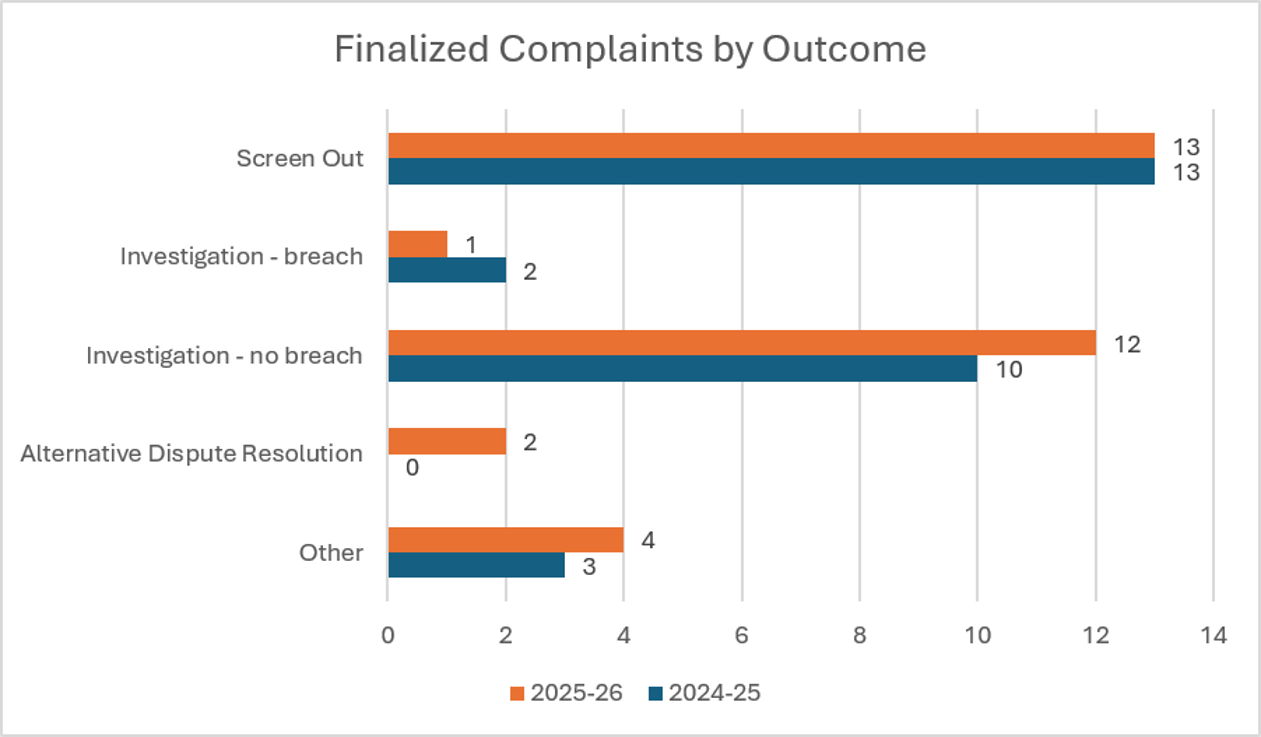
Text format - Figure 1: Finalized complaints by outcome in 2025-26
Figure 1: Finalized complaints by outcome in 2025-26
| Outcome | Number of decisions 2024-25 | Number of decisions 2025-26 |
|---|
| Screen out | 13 | 13 |
| Investigation - breach | 2 | 1 |
| Investigation - no breach | 10 | 12 |
| Alternative Dispute Resolution | 2 | 0 |
| Other | 3 | 4 |
Complaints by outcome in 2025-26
| Outcome | Number of decisions | Description of the outcome |
|---|
Screened out | 13 | The allegations were not about member conduct. Most of these allegations were about a member's decision, hearing management, or the way the Member questioned parties. |
Frivolous and Vexatious (F&V) | 0 | No files were deemed to be Frivolous and Vexatious (F&V); however, all complaints are screened to determine if they fit the criteria for F&V. |
Investigated – No Breach | 11 | Investigations found that either the alleged conduct did not occur, or that there was not enough evidence to support a finding of a breach of the Code. |
Alternative Dispute Resolution | 2 | Complaints were informally resolved to the satisfaction of both parties. |
Investigated - Breach | 1 | One member was found to have breached section 9 during a hearing. |
Withdrawn/Abandoned/Other | 4 | Complainants chose not to pursue their complaint or did not respond to communication from the Ombudsperson’s Office. |
In 2025-26, about 68% of finalized complaints were from counsel (21 of 31 complaints) and 26% directly from claimants, appellants or persons concerned (8 of 31 complaints). The remaining two complaints were submitted by a designated representative and an observer.
Figure 2: Source of finalized complaints 2025-26
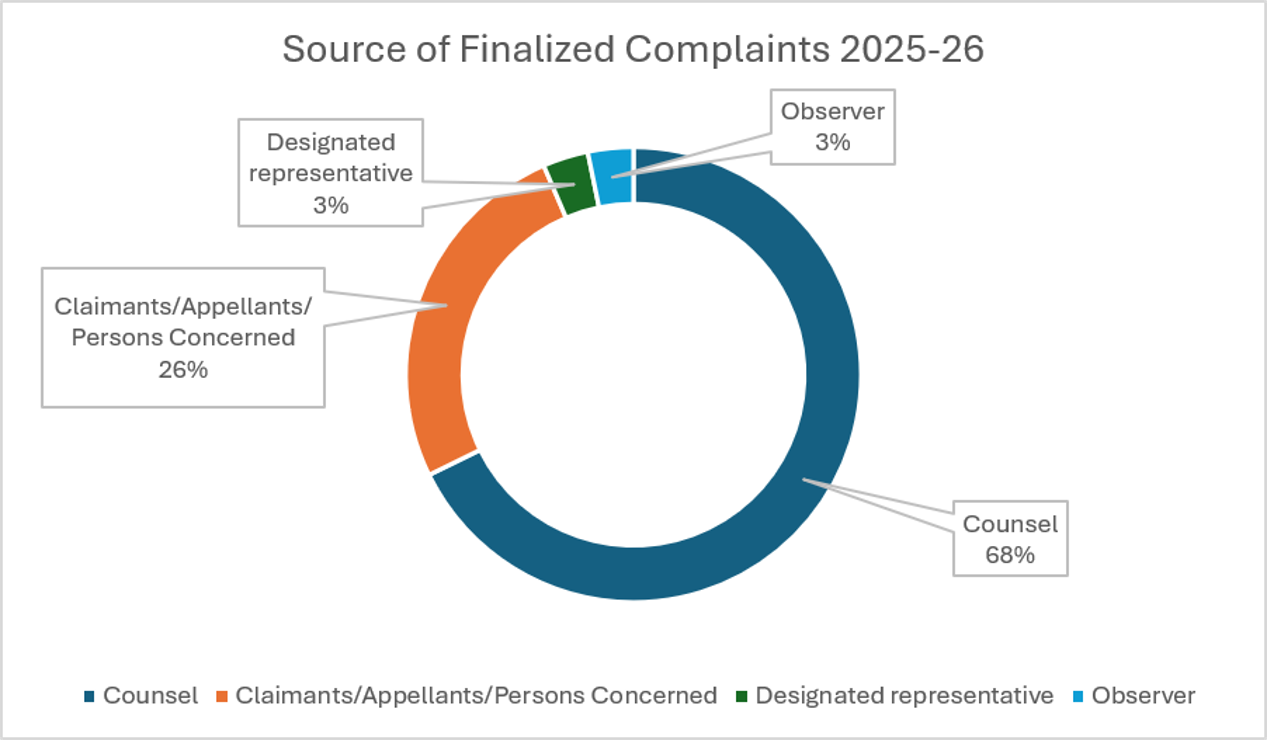
Text format - Figure 2: Source of finalized complaints 2025-26
Figure 2: Source of finalized complaints 2025-26
| Source | Percentage |
|---|
| Counsel | 68% |
| Claimants/appellants/persons concerned | 26% |
| Designated representative | 3% |
| Observer | 3% |
Alternative Dispute Resolution (ADR) is a voluntary process that provides increased control to both parties, and which is described in Section 5 of the Procedures. With the support of the Office of the Ombudsperson, members can provide self-reflections to respond to the complainant’s concerns. ADR provides the parties with an opportunity to move forward and work together in future hearings in a positive manner. ADR was initiated three times in 2025-26, with two of the complaints resolved and one returning to investigation. Feedback from parties has been very positive, and we hope to increase the percentage of complaints resolved through ADR in the future.
Sections of the Code of Conduct referenced in complaints (2025-26):
| Section | Total number of references | Screened in for investigation |
|---|
| 9 | Members shall conduct hearings in a courteous and respectful manner. | 24 | 14 |
| 10 | Members shall exercise their duties without discrimination. Members must take reasonable measures to accommodate all participants in a proceeding so that they may participate effectively. Members are expected to take into account social and cultural differences and to respect human rights. | 17 | 4 |
| 11 | Members are expected to act honestly and in good faith, in a professional and ethical manner. | 19 | 1 |
| 12 | Members shall conduct themselves with integrity and avoid impropriety, or the appearance of impropriety. | 14 | 1 |
| 13 | Members have a responsibility to perform their duties in a manner that fosters collegiality among members and with staff and to treat them with courtesy and respect. Members are expected to assist their colleagues through the respectful exchange of views, information and opinions. | 10 | 0 |
Timeliness
During the 2025-26 reporting period, complaints were (see
Table 1 below):
-
acknowledged within the established service standard
92% of the time
-
screened within the service standard
32% of the time
-
final decision letters sent within the service standard
50% of the time
Table 1: Service standards results for 2025-26
| Type | Description | Standard | Target % | 2025-26 Result % |
|---|
Acknowledgment | Acknowledgment letter sent to complainant following receipt of the complaint | 5 calendar days from receipt of complaint | 100 | 92 (33/36) |
Screening | Screening decision letters sent to parties following screening | 60 calendar daysFootnote 1 from receipt of complaint | 80 | 32 (9/23) |
Final decision | Final decision letters sent to parties following investigation | 170 calendar daysFootnote 1 from receipt of complaint | 80 | 50 (6/12) |
The time it takes to analyse a complaint, formulate a recommendation, and make a decision at any stage of the process varies depending on the complexity of the file.
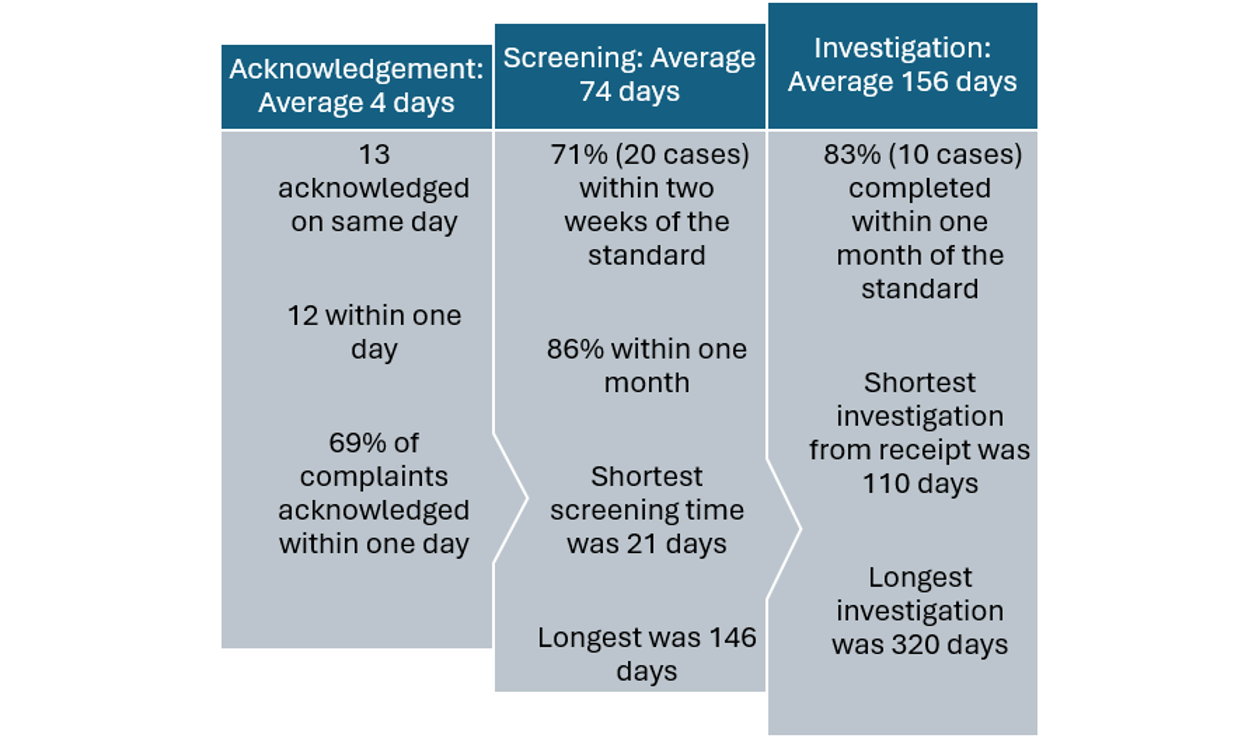
Text format - Figure 3: Service standards
Figure 3: Service standards
| Acknowledgement: Average 4 days | Screening: Average 74 days | Investigation: Average 156 days |
|---|
- 13 acknowledged on same day
- 12 within one day
- 69% of complaints acknowledged within one day
| - 71% (20 cases) within two weeks of the standard
- 86% within one month
- Shortest screening time was 21 days
- Longest was 146 days
| - 83% (10 cases) completed within one month of the standard
- Shortest investigation from receipt was 110 days
- Longest investigation was 320 days
|
Conclusion
Going forward, the Office of the Ombudsperson will continue to administer the member complaints process in a fair and transparent way. We will continue to screen and investigate complaints efficiently, communicate with parties clearly, and manage the overall member complaints process effectively. The Ombudsperson will continue to provide her analysis and observations and areas for improvement (such as training) to senior management, while respecting the neutrality of her office.
Annex A – Case summaries
Case Summaries of finalized complaints in 2025-26
Section A: Investigation - breach
Section B: Investigation – no breach
Section C: Screened out
Section D: Other